

Survival Rating: 9 / 10 — Passable. If You Don’t Make These Mistakes.
The Stat That Should Terrify You Into Reading This
The success rate for prop firm evaluations sits at approximately 14%, meaning roughly 86% of traders never reach a funded account.
Let that number breathe for a second. Out of every 100 people who pay to take an Apex evaluation, 86 of them never see a funded account. They blow the trailing drawdown. They run out of the 30-day window. They make a rule they didn’t fully understand. They revenge trade one bad morning into a reset fee.
This review is not about whether Apex is legit — it is, $660 million in payouts settles that debate. This is about the 86% — the traders who had the ambition and the fee but not the preparation. It’s a field guide to what actually trips people up, told in the order you’ll encounter each problem from the moment you click “buy evaluation” to the moment you request your first withdrawal.
Read this before you spend a dollar. You’ll thank yourself later.
Mistake #1 — You Picked the Wrong Account Before Reading Anything
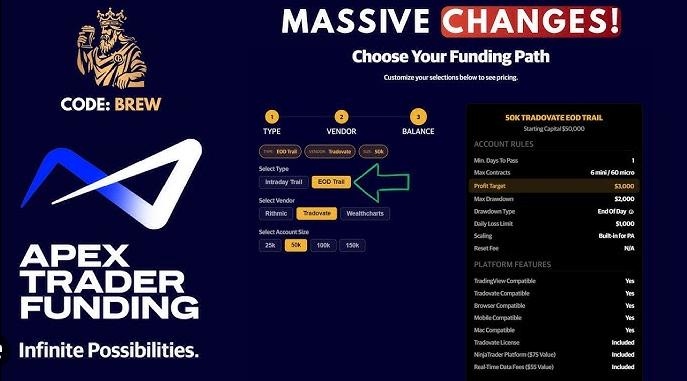
This is where the bleeding starts. Before you ever place a trade, you make the two decisions that will define your entire Apex experience: EOD or Intraday drawdown. And which platform.
It is important that you choose the correct plan on the website or dashboard. If you select the wrong plan or platform, there will be no refunds, with no exceptions. Apex incurs charges for every new account setup and cannot issue refunds for user mistakes. Please read all options carefully before you click to pay.
No refunds. No exceptions. Wrong plan, wrong platform — you eat the cost and start over.
So here is what you actually need to know before choosing. As of March 2026, the two options are End-of-Day (EOD) Trailing Drawdown and Intraday Trailing Drawdown.
Intraday trailing tracks your highest unrealized profit in real time throughout the session. Every tick up that your position gains raises the trailing floor — even if you haven’t closed the trade yet. So if you’re up $2,000 unrealized, hold for another hour, give back $800, and close at $1,200 — your trailing threshold moved to the $2,000 peak, not the $1,200 you actually locked in. That’s the brutal math of intraday trailing.
EOD trailing only recalculates at market close based on your closed P&L. Hold through a $3,000 intraday swing, close flat, and your drawdown threshold hasn’t moved. This is the more forgiving model for traders who let positions run.
The EOD PA, until your closing balance exceeds the drawdown threshold plus $100 — the safety net — you can only trade half the max PA contracts. Once your balance clears the threshold, full size unlocks the next session.
The practical implication: if you’re a scalper who opens and closes everything within minutes and never holds unrealized gains long — Intraday might actually be fine for your style. If you’re a position trader who lets winning trades breathe through volatility — EOD protects you from getting stopped out by your own peak unrealized profit.
Get this decision wrong and you will feel it on day one.
Mistake #2 — You Didn’t Notice the Contract Limits Change When You Get Funded
This is one of the most common Apex mistakes. Strategies that work during eval at max contracts break the moment the PA halves the limit.
This catches experienced traders just as often as beginners. During the evaluation phase, you have access to the full contract limit for your account size. When you pass and move to a Performance Account, those limits drop — sometimes significantly.
The $25K drops from 4 contracts in eval to 2 on the PA. The $50K stays at 6 during eval then 4 on the PA. The $100K drops from 8 to 6. The $150K drops from 12 to 9.
You spent three weeks perfecting a strategy that requires 8 contracts on a $100K account. You pass the eval trading 8 contracts. Day one of your funded account, you try to execute the same strategy and find you’re capped at 6. Either the math doesn’t work or the stops don’t fit the structure anymore.
Plan your sizing around the PA limits, not the eval limits. Otherwise your strategy works during eval and breaks the moment you get funded. I see this trip up new Apex traders weekly — they pass eval at 8 contracts, get funded, hit a 3-contract cap on day 1 of the PA, and immediately feel the air come out.
The fix is simple but requires forethought: practice the evaluation using the PA contract limits, not the eval limits. Yes, you’re leaving performance on the table during the eval by undersizing. But you’re building a strategy that will actually survive into the funded phase rather than one that dies on the transition.
Mistake #3 — You Forgot the 30-Day Evaluation Clock Starts When You Buy
Every Apex evaluation has 30 calendar days from purchase to pass. That is roughly 21 to 22 trading sessions depending on holidays. Apex does not offer extensions, pauses, or resets. If you do not hit the profit target inside 30 days you have to buy a new eval. The clock starts when you buy, not when you first log in. Do not sit on an eval for a week before opening the platform.
Straightforward but consistently ignored. You buy the evaluation on a Friday intending to start Monday. You get busy. You start the following Wednesday. You’ve already burned 5 calendar days — roughly 3–4 trading sessions — before you placed a single trade. In a 30-day window with 21 trading sessions, that’s not nothing.
In 2026, passing a prop firm challenge takes 12 to 22 trading days for sustainable success. If you need 12–22 trading days and you’ve already burned 5 calendar days, you’re executing against a compressed timeline from day one.
Buy the eval when you’re ready to start. Not as motivation to start. Not as a future goal. When you have your strategy defined, your risk parameters set, and your schedule cleared for active trading. The clock waits for nobody.
Mistake #4 — You Misunderstood the 50% Consistency Rule
The consistency rule is the rule that creates the most painful delayed payout experiences. And it’s misunderstood in a very specific way.
The 50% consistency rule: your single best trading day cannot account for more than 50% of your total profit at the time of the payout request.
Here’s where traders go wrong. They read this rule, think they understand it, and then have a monster day early in their payout cycle. Let’s say you catch a perfect breakout on the NQ on day two of your cycle and pull $4,000 in a single session. Your total cumulative profit is $4,500. That one day represents 89% of your total profit. You cannot request a payout until subsequent trading days bring that percentage below 50%.
At $4,500 total profit with day two representing $4,000 of it, you need to accumulate at least another $3,500 in profits across other sessions before the big day drops below the 50% threshold. If the market goes quiet or you take a few small losses, that requirement extends.
The strategic response is counterintuitive but clear: after a very large winning day, keep trading. Don’t coast. Don’t take the next three days off because you feel like you’ve already earned it. Every additional profitable session dilutes the big day’s percentage share of your total.
Pick the drawdown model that fits your trading style, understand how the payout ladder and consistency rule work before you start, and track your metrics daily.
Track the percentage daily. Not weekly. Not when you feel like you’re ready to withdraw. Daily. Know where you stand every morning before you open the platform.
Mistake #5 — You Didn’t Know Metals Are Suspended
This one is recent, specific, and absolutely ruins the day of any trader who finds out the hard way.
As of March 14, 2026, all metals contracts are suspended at Apex Trader Funding. The halt applies to evaluation and Performance Accounts. No return date has been published. Trading a halted instrument can result in account termination.
Gold traders, silver traders, anyone who built their strategy around GC, SI, MGC, HG — you need a new instrument. The metals suspension happened two weeks after the 4.0 launch with minimal fanfare, and older reviews still show metals as available.
The full instrument list currently includes equity index futures such as ES, NQ, YM, RTY and their micros, currencies including 6E, 6B, 6J, 6A, 6C, 6S, energy such as CL, NG, MCL, agriculture including ZC, ZS, ZW, ZL, LE, HE, and crypto via MBT and MET.
If your strategy is on NQ, ES, CL, or any of the standard index futures — you’re fine. If you were planning to trade gold — you need to adapt or look elsewhere until the suspension lifts.
Mistake #6 — You Assumed the Activation Fee Doesn’t Exist
The PA activation fee is a one-time charge after you pass the evaluation: $99 on EOD Performance Accounts and $79 on Intraday Performance Accounts. It is due within 7 calendar days of passing. Promo codes do not discount this fee — they only discount the eval. On a $100K EOD bought at 90% off — about $30 — the real total before withdrawal is roughly $129. Many traders miss this and feel ambushed when the bill hits.
This is not a scam. It’s in the terms. But the way Apex markets the 80% and 90% off promotions makes many traders calculate their all-in cost as just the discounted evaluation price. Then they pass — which should be a great moment — and get hit with an unexpected fee they need to pay within a week.
Budget the activation fee from day one. Your real cost to get to a funded account is evaluation fee plus $79 or $99. On a discounted $50K eval that costs $30, your actual all-in is $109–$129. Still extraordinarily low relative to the potential payout. Just know it’s coming.
Mistake #7 — You Let the Account Go Dormant
This one is obscure enough that most reviews never mention it. But it’s in the rules and it has a permanent consequence.
To keep your PA active, you must record at least 2 trading days with $50 or more in net profit within every rolling 30-day period. After 15 days without meeting this threshold, the account enters a dormant phase with daily email reminders. If 30 consecutive calendar days pass without qualifying activity, the PA is permanently closed and cannot be reinstated.
Permanently closed. Cannot be reinstated. The funded account you worked to earn — gone because you went on vacation for five weeks without placing a single trade that generated $50 in profit.
The practical protection is simple: set a recurring calendar reminder. If you’re taking time off from active trading, log in at least twice a month and make at least two profitable sessions of $50 or more. It doesn’t have to be a full trading day. It has to be $50 in realized net profit twice in 30 days. On micro contracts, that’s trivially achievable. Just do it.
Mistake #8 — You Traded Like It Was the Evaluation When You Got to the PA
The psychological shift from evaluation to funded account breaks more traders than the rules do. In the evaluation, a blown account costs you a reset fee. In the Performance Account, a blown account costs you the entire funded opportunity.
As someone who’s been coaching beginner traders for years, I know how easy it is to burn through capital in a brokerage account. Don’t spend thousands on beginner mistakes. With Apex, the worst case in the evaluation is losing the fee and resetting for $50. When you can pass and get paid is when you’re ready to trade with a direct brokerage.
Evaluation psychology and funded account psychology need to be different. In the eval, some traders swing larger knowing the downside is capped at a reset fee. In the PA, that same aggression applied to a trailing drawdown that tracks peak unrealized profit will end the account fast.
Always remember: you are trading a drawdown, not a balance. Treat the evaluation fee as a business expense, not a lottery ticket.
The traders who make it through consistently — who build withdrawal history across multiple accounts over multiple months — approach the PA with more discipline than they used in the evaluation, not less. The funded account is where real risk management matters, because there is no reset fee. There is just starting over.
What Consistent Success Actually Looks Like
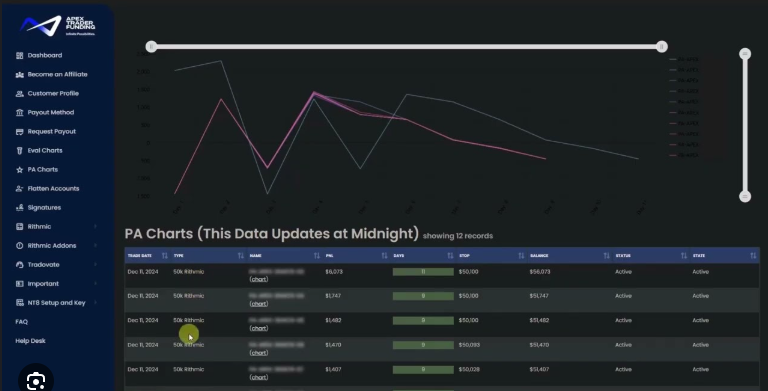
To close the loop, here’s what the trajectory of a successful Apex trader actually looks like — based on documented community experiences and verified payout patterns.
John traded the MES using daily support and resistance levels. Because there was no deadline pressure, he took 42 days to reach his profit target on a $50K account, taking only high-probability setups. He’s now withdrawn over $12,000 in total profits as a consistent Performance Account holder.
42 days. No urgency. High-probability setups only. No revenge trades. No swinging for the fences to hit the target faster. Just systematic execution of a defined strategy until the math worked.
You can start an evaluation for as little as $30 to $50 when they’re running a sale. If you fail, the worst-case scenario is you lost a hundred bucks — not $10,000 of your own hard-earned savings. That’s a tradeoff that makes sense every time.
The evaluation is a cheap audition. The Performance Account is where the career starts. The 14% who make it through aren’t necessarily better traders than the 86% who don’t. They’re more prepared. They read the rules twice. They practiced on the PA contract limits during the eval. They tracked the 50% consistency percentage daily. They set calendar reminders so the dormancy clock never ran out.
Preparation is the edge. Not talent. Not a secret strategy. Not a special indicator. Preparation.
The Practical Checklist Before You Buy
Before spending a single dollar on an Apex evaluation, run through this:
Your strategy has been profitable for at least 60 days on a simulated account with PA-level contract limits — not eval limits.
You have chosen between EOD and Intraday drawdown based on your actual trading style, not which sounds better in a YouTube video.
You have calculated your real all-in cost including both the discounted evaluation fee and the $79 or $99 activation fee.
You know which instruments you trade and have confirmed none of them are currently suspended — especially if you trade metals.
You understand the 50% consistency rule and can calculate your current day’s percentage share of total cycle profit without using a calculator.
You have a calendar reminder set to place at least two qualifying profitable sessions every 30 days once funded.
You have accepted that the 30-day evaluation clock starts at purchase and scheduled your first trading session for within 24 hours of buying.
If you can check every one of those boxes honestly — not aspirationally, honestly — you’re in the 14%. If you can’t, spend another few weeks in simulation before spending money.
Final Scorecard — The Survival Edition
| Category | Score | Survival Note |
|---|---|---|
| Evaluation Clarity (4.0) | 9.0/10 | Binary rules — but read every word of them |
| EOD Drawdown Option | 9.5/10 | Game-changing for position traders |
| 30-Day Eval Window | 7.0/10 | Manageable, but unforgiving if you waste days |
| Contract Limit Transition | 6.5/10 | Eval to PA drop catches people every single week |
| 50% Consistency Rule | 7.5/10 | Fair, but needs daily tracking discipline |
| Metals Suspension (March 2026) | N/A | Just know about it before you plan your strategy |
| Activation Fee Transparency | 6.5/10 | Legitimate, but buried in fine print |
| Dormancy Rule | 7.0/10 | Permanent consequence, almost nobody mentions it |
| Payout Speed (4.0 system) | 8.0/10 | Automated now, hours not weeks |
| Overall Survivability | 🌟 4.3 / 5 | The rules are fair — if you actually know them |
This article is for educational purposes only and does not constitute financial advice. Futures trading and prop firm evaluations involve significant risk. Rules change frequently — always verify current terms directly with Apex Trader Funding before making any purchase decision.